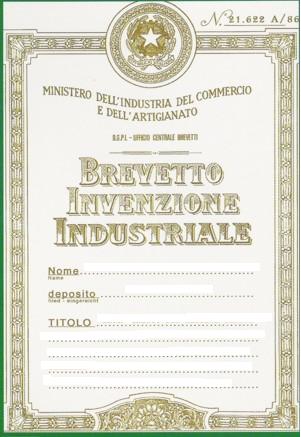
The patent gives the right to manufacture and sell exclusively an object or a system on the territory of the state in which it is required. In Italy there are two types of patent, which joins the registration of the design registration, which covers only the form or the "design" of a product. To deposit
a patent for invention or utility model, it is unnecessary to have a prototype, but just want to know how the object or the system must be achieved by providing a description in this regard. However, they must be present the following requirements: novelty, originality, industrial legality.
I think there are many problems on the concept of patents that must be solved in the future.
The first and perhaps most important question concerns the concept of design.
When the mind conceives an idea of \u200b\u200bany kind must necessarily use of prior knowledge that might often have been conceived by others in recent times and therefore should be recognized as such in the definition the patent.
An innovative idea, therefore, is essentially the use of concepts previously defined by human knowledge in a logical structure that allows you to define a new cognitive superstructure not previously defined.
Therefore, any human idea can be traced back to a logical scheme which has the components previously defined concepts and ideas.
Never mind that the innovative idea is applied in a reproducible physical or an abstract context, the substance remains the same: the confirmation of this lies in the fact that the human mind to produce ideas that follows the same mental processes in all areas of human knowledge.
Each patent, therefore, should consist in storage in a database of the new idea in the form of new component of human knowledge, in the definition of the idea by a schematic that uses the components previously registered or otherwise recognized as existing assets of 'human being, even if they are not covered by copyright.
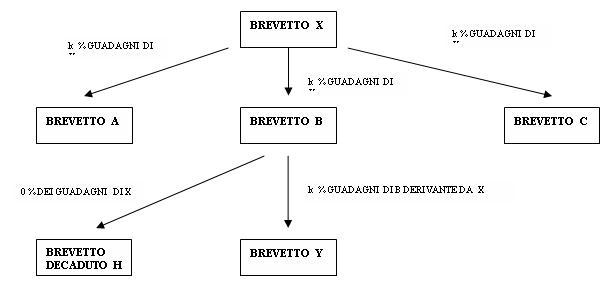
The second highlight of the new definition of a patent to be explored is implicit recognition of the use of other patents (if they are registered ideas) and ideas developed by others. Just in case, however, the components of "cognitive" A, B, C, .. used in the definition of the new idea is also patented X patents will be valid for a minimum percentage of income to A, B, C, .. patent covering the use of X.
In this way there will be gains from even those who do not have a commercialized an idea, patented it.
addition to being more just, in my view, that view of the patent is also most suitable for the future economy of the industrialized countries must, of necessity, always give more weight to technological innovation: the countries that have invested in research in the past should have recognized their efforts by countries emmergenti also found to exploit today's technologies to create business without giving any significant contribution to research. Also
research could be funded adequately, even if it is theoretical, from simple record of scientific discovery or invention as a patent.
The patent has a finite time after which a valid decade. To promote high level research which they were created resulting in many patents as possible ... it would also introduce a renewal of a patent for a time proportional to the number of patents resulting from a secondary registration.
An 'Another advantage of this way of seeing the patent consists in the complete protection from abuse due to the difficulty of controlling all the thousands of existing patents around the world before verifying the originality of the patent: not happening often in fact that such ideas are patented ...
addition, this design leaves the field free of patent protection of innovations in the software field: every algorithm can in fact be represented in a logical framework (see, eg, UML and design patterns), as any other innovative idea.
As a final important point to further analyze the context in which we must apply the exercise of patent rights.
Recognition of production and / or illegal trade of an object (real or abstract) patented should only be applied when you use an idea born of X to generate profit in the third person or entity.
A patented idea (even if the schema of a physical machine feasible) or not, however, must be reproduced and used freely for academic use, research or personal study.
In the final analysis we can see that it is never the physical object that is patented but the idea that it is based, and that it is reproduced in 'a physical or virtual, can generate profit.
The patent, therefore, is nothing but the right of every human being that he recognized the paternity of her idea and the right to exclusive production and marketing of the idea (and its reproductions of any materials) as a legitimate form of income: this right should not be acquired by paying any amount.


0 comments:
Post a Comment